It is a glorious day outside--May has treated us well, weather-wise--but I am tucked in bed at noon on a Tuesday. First the Mister got sick, this weekend, when we had planned a grand excursion to Brussels that included a trip to see this Baby Animals exhibit at the Natural History museum. Gabriel was so excited. We didn't go, especially when I woke the next morning with stomach upset and cramping.
I thought I was feeling better, and managed to get through the day yesterday, albeit weak and dizzy, but threw in the towel and asked the Mister (who still isn't feeling great himself) to come home early, and then experienced the worst night of, um, intestinal distress I've ever had. The kind where I had to throw the baby back in his crib and listen to him scream at 3:30 am while I hunched in the bathroom. I had to yell to M (who has been sleeping in the guest room for a few nights so he doesn't wake the baby with snuffles and sneezing, or pass on whatever he has) for help. Oof. I've barely eaten for three days.
I'm praying, hard, that I recover, and that the kids don't get sick, because we fly to Boston on Friday for a couple of weeks. This trip was already planned (I'm scheduled to present a paper at a conference), but it's providential that we're headed to see my family now.
Because mom's cancer is back. Another tumor, another round of different treatments. We're still waiting to find out what's ahead, and absorbing this news. My birthday is tomorrow, Mother's Day is Sunday, and my mom's birthday is a week after that. Somehow all of this, and being sick myself, coalesces into a swirl of fever dreams and happy sadness. Sad happiness. Being sick inside on a perfect May day. I think about her in the walking moments and the still moments.
Friday I stopped in our beautiful Beguinage just to breathe a little, listen to birds chirp in silence, to soak up the delicate morning sunlight and gentle breeze. And I thought about mom, feeling worried and brave at the same time, scared and calm and trusting that she--we--will all just take this as it comes.
I came across this poem by e.e. cummings, one I hadn't known before, and somehow it's the right poem for right now, winter by spring. The right poem for sitting in the Beguinage, asking God to give me the patience of mountains. I lift my diminutive spire to merciful Him.
Poem 77, from 95 Poems
e.e. cummings
i am a little church(no great cathedral)
far from the splendor and squalor of hurrying cities
--i do not worry if briefer days grow briefest,
i am not sorry when sun and rain make april
my life is the life of the reaper and the sower;
my prayers are prayers of earth's own clumsily striving
(finding and losing and laughing and crying)children
whose any sadness or joy is my grief or my gladness
around me surges a miracle of unceasing
birth and glory and death and resurrection:
over my sleeping self float flaming symbols
of hope,and i wake to a perfect patience of mountains
i am a little church(far from the frantic
world with its rapture and anguish)at peace with nature
--i do not worry if longer nights grow longest;
i am not sorry when silence becomes singing
winter by spring,i lift my diminutive spire to
merciful Him Whose only now is forever:
standing erect in the deathless truth of His presence
(welcoming humbly His light and proudly His darkness)
07 May 2013
My diminutive spire

23 April 2013
Always fragrant, benign
Today is my favorite Catalan holiday, Sant Jordi. I love it because it has all the nice things: gifts for your loved ones, flowers and books, history and legend (Saint George and the dragon).
The Mister left at 5 am for a quick overnight business trip, but when I made my way downstairs with the kids a red rose and a wrapped book were waiting for me on the table.
April has been sluggish and cold: the sun shines, but without warmth. A gusty wind blows that requires me to don my hat and scarf and gloves. However, I've stubbornly broken out my spring clothes, deceived by a few warm days during which we (and everyone else here) practically fell over ourselves to have picnics in the park and eat ice cream. So I'm usually too cold as I schlep the kids around, gritting my teeth into the wind.
Gabriel went easter egg hunting in the snow (oh, our little trip to the Ardennes was a big success! but then we all got sick again the following week). I keep thinking it HAS to get better. It will.
In the meantime, a poem for Sant Jordi's day by Salvador Espriu, the great Catalan poet. Soon the suffering dragon, the boredom, the cold rain will be locked away...
Les Roses Recordades
Salvador Espriu
Recordes com ens duien
aquelles mans les roses
de Sant Jordi, la vella
claror d'abril? Plovia
a poc a poc. Nosaltres,
amb gran tedi, darrera
la finestra, miràvem,
potser malalts, la vida
del carrer. Aleshores
ella venia, sempre
olorosa, benigna,
amb les flors, i tancava
fora, lluny, la sofrença
del pobre drac, i deia
molt suament els nostre
spetits noms, i ens somreia.
Remembered Roses
Salvador Espriu
Do you remember how those hands
brought us the roses of Sant Jordi,
the old April light? It rained
slowly. Us, bored and maybe ill
behind the window, watching
the street life go by. Then
she came, always fragrant,
benign, with flowers,
and she locked the suffering
of the poor dragon away, far away,
and she ever so softly said
our dear names, and smiled at us.
13 September 2012
The lively air
It's been a while since I've posted any poetry. An old favorite of mine by Theodore Roethke has been ringing in my ears lately, especially as I feed Eloi. Its rhythm, its meanings easily adapt to feeding a tiny baby:
The Waking
I wake to sleep, and take my waking slow.
I feel my fate in what I cannot fear.
I learn by going where I have to go.
We think by feeling. What is there to know?
I hear my being dance from ear to ear.
I wake to sleep, and take my waking slow.
Of those so close beside me, which are you?
God bless the ground! I shall walk softly there,
And learn by going where I have to go.
Light takes the Tree; but who can tell us how?
The lowly worm climbs up a winding stair;
I wake to sleep, and take my waking slow.
Great Nature has another thing to do
To you and me, so take the lively air
And, lovely, learn by going where to go.
This shaking keeps me steady. I should know.
What falls away is always. And is near.
I wake to sleep, and take my waking slow.
I learn by going where I have to go.
~Theodore Roethke
***
The poem captures those blurred lines between thought and emotion, between knowledge and physical motion, between fear and joy--all of it grasped better in the twilight deliciousness between sleeping and waking. I think babies must experience all of this in an instinctual mesh of sensory input, and that Roethke's rhythms reach toward a lullaby to that end. So what I hear as I think of these lines from my baby's perspective goes something like this:
The Feeding
I wake to nurse, and take my waking slow.
I feel my way to feeding and I have no fear.
I grow by nuzzling in these arms I know.
We think by feeling. What is there to know?
I grin a milky grin from ear to ear.
I wake to nurse, and take my waking slow.
Of those so close beside me, which are you?
My mama! I see her and smile softly there,
and grow by nuzzling in these arms I know...
24 May 2012
All delight unclouded
Suddenly, Belgium has decided that spring-into-summer is here, and we've had a few days of sunny, even muggy weather in the upper 70s, without any rain (even though rain was predicted). This is, of course, a welcome change and one that makes me more energetic and ready to have this baby! I've discovered that I have exactly four short-sleeve or sleeveless maternity shirts, which should be enough to get me by--although this will be annoying in the short term (especially since even these shirts barely cover my belly any more), it makes me glad that I didn't go out and buy more spring maternity wear, since it's really not worth it for just a couple of weeks.
Gabriel comes home from daycare sweaty and simply coated in sand from head to toe, since they spend the days outside and there's a large sand pit to play in. But he's cheerful and giggling and growing and every day saying new words and sentences--especially adding more verbs into the mix. "Is" is actually pretty new, and I adore how he pauses before and after saying it, giving the "s" a nice long hiss. "Dat...issss...broken, mama!" He came inside from the yard the other day proudly bearing a scraggly bouquet of dandelions minus their seeds, and gave them to us. Candles! he said, because we blow on them. He's also potty training basically on his own, since I had kind of assumed it wouldn't happen before the baby and we were just following his pace. Even a few weeks have made a big difference, and now we have the dilemma of whether to put him in underwear or continue with diapers to get us through the newborn stage.
This week and next I'm studying for my Dutch exams, and there is an awful lot of material to cover. I thought, going into this and knowing that the term would end just before my due date, that Dutch would help distract me from pregnancy/baby thoughts, but the reverse is true. I'm not exactly a dedicated student right now and I kind of figure that I'll do as well as I'll do on the exams (if I even make it to the last one!).
Meanwhile, I'm still having poetry discussion group and book club meetings and doing other fun things. We happen to be discussing Rukeyser again this week, and since I'm waiting for our baby, I especially enjoyed "Nine Poems for the Unborn Child." Here are a couple of sections that I liked...
Nine Poems for the Unborn Child
by Muriel Rukeyser
3
There is a place. There is a miracle.
I know the nightmare, the black and bone piano,
The statues in the kitchen, a house dissolving in air.
I know the lilac-turreted cathedral
Taking its roots from willows that changed before my eyes
When all became real, real as the sound of bells.
We earthly are aware of transformation;
Miraculously, life, from the old despair.
The wave of smooth water approaches on the sea-
Surface, a live wave individual
Linking, massing its color. Moving, is struck by wind,
Ribbed, steepened, until the slope and ridge begin;
Comes nearer, brightens. Now curls, its vanishing
Hollows darken and disappear; now high above
Me, the scroll, froth, foam of the overfall.
8
Child who within me gives me dreams and sleep,
Your sleep, your dreams; you hold me in your flesh
Including me where nothing has included
Until I said : I will include, will wish
And in my belly be a birth, will keep
All delicacy, all delight unclouded.
Dreams of an unborn child move through my dreams,
The sun is not alone in making fire and wave
Find meeting-place, for flesh and future meet,
The seal in the green wave like you in me,
Child. My blood at night full of your dreams,
Sleep coming by day as strong as sun on me,
Coming with sun-dreams where leaves and rivers meet,
And I at last alive sunlight and wave.
22 February 2012
Poppy and memory
I'm immersed in Paul Celan these days, and as ever I find his poetry incredibly moving, uncanny, shadowed, suggestive, and brilliant. I am scheduled to discuss his work with a doctoral student here who studies theology and philosophy, so those elements of the poems, which of course are tangled and challenging, are engaging my brain cells most prominently.
Celan is most known for his poetry of witnessing and loss, poetry that (ironically) attests to the devastating effects of the Holocaust on language and culture. But despite all of that, right now I find myself most drawn to Celan's love lyrics, even tinged as they are with this darkness. I suppose it's because the Mister and I are very in tune right now, two stones shaped and smoothed by one another and by the waters surrounding us. With this pregnancy, mysterious forces bring us together...we see one another in the same ways as ever, and in new ways: "More similar. Stranger."
In "Corona," the moon imagery, the sea imagery, the declaration of "It is time" (and, especially in combination with the other poem, the blooming stone)--they all speak to me both about waiting for this birth and being ever more in love, which probably has absolutely nothing to do with what Celan was thinking! But that's the beauty of poetry.
The Slope
~by Paul Celan
You live beside me, like me:
as a stone
in the sunken cheek of night.
Oh this slope, my love,
where we tumble incessantly,
stones,
from rivulet to rivulet.
Rounder, as time goes by.
More similar. Stranger.
And oh this drunken eye
that wanders around here the way we do
and sometimes, astonished,
sees us as one.
("Die Halde," tr. David Young)
Corona
~by Paul Celan
Autumn nibbles its leaf right from my hand: we're friends.
We shell time from the nuts and teach it to walk:
time turns back into its shell.
In the mirror is Sunday,
in dream goes sleeping,
the mouth speaks true.
My eyes goes down to my lover's loins:
we gaze at each other,
we say dark things,
we love one another like poppy and memory,
we slumber like wine in the seashells,
like the sea in the moon's blood-beam.
We stand at the window embracing, they watch from the street:
It's time people knew!
It's time the stone consented to bloom,
a heart beat for unrest.
It's time it came time.
It is time.
("Corona," tr. John Felstiner. Felstiner sees this as a response to Rilke's "Autumn Day" and "Autumn," both poems that I also love, and the latter of which I posted a few years back.)
15 January 2012
A tremolo rises
A funny gift coincidence, this Christmas. For the longest time, a few years perhaps, I've had a volume of Tomas Tranströmer's poetry, The Great Enigma, languishing at the bottom of my Amazon wish list. I hadn't read much of his work, but what I'd read always made me want to explore more of the Swedish poet's writing. So when I came across that very book the day that I defended my thesis, as I wandered around town happily, I bought it without hesitation as a little "go Dr. me!" reward.
A couple of weeks later, opening gifts from my parents, what should I unwrap but the very same book! I had even been careful to delete it from my Amazon list after I bought it, but my mom had her shopping done early this year, and for whatever reason that was the one she chose to get. Accurately, it turns out, guessing that I really wanted it if it had been on the list for so long (she's very good at picking out good gifts)--too accurately in this case, as I never dreamed anyone would go for that one instead of the cookbooks or new novels also on my list.
In fact, I had been worried that I'd get a duplicate copy of Haruki Murakami's 1Q84, since the Mister gave me that as a present just before we left for the US when we had our little family Christmas. I've just started delving into it this week, with all the anticipation that a nice fat hardcover of a favorite writer brings, and I'm already loving it. All the hallmarks of Murakami's fantastic blend of real and surreal are there, even in the first pages, as one main character, whose odd name means "green peas," climbs down off a gridlocked freeway via an emergency ladder, and another is tapped to rewrite a young author's literary prize entry.
Anyway, back to Tranströmer. I realize it's been a very long time indeed since last I posted any poetry here, so I thought a selection from him today would be nice. It was below freezing but a bright sunny sky as we walked to church this morning, the kind of cold air that hits you hard but makes you somehow happy. I think Tranströmer captures that in this little winter poem, and surprises you in the end with a comparison to a summertime experience.
There Is Peace in the Surging Prow
~by Tomas Tranströmer
On a winter morning you feel how this earth
plunges ahead. Against the house walls
an air current smacks
out of hiding.
Surrounded by movement: the tent of calm.
And the secret helm in the migrating flock.
Out of the winter gloom
a tremolo rises
from hidden instruments. It is like standing
under summer's high lime tree with the din
of ten thousand
insect wings above your head.
25 June 2011
No other words in the world
A propos of yesterday's post on toddler words, I just came across a George Oppen poem written to a newborn, part of which reads:
....Sara, little seed,
Little violent, diligent seed. Come let us look at the world
Glittering: this seed will speak,
Max, words! There will be no other words in the world
But those our children speak. What will she make of a world
Do you suppose, Max, of which she is made.
From "Sara in Her Father's Arms" by George Oppen
25 April 2011
All song, all singing
Happy Easter! It's been raining for what seems like forever, but spring is in the air. I'm hoping that these April showers really do bring May flowers. We had a lovely Easter yesterday. Gabriel joined in the egg hunt like he's being doing it all his life, spotting all of the colorful eggs, toddling over to them, cracking them open, and holding up his treasures with a big "ooooh!!!!" for us all to marvel at.
I handed in my beast of a dissertation draft a week ago Friday, and have now had two work-free weekends, which felt glorious. The first time in ages I read the Sunday paper from start to finish, got some baking done, and took afternoon naps. There's still a long haul of editing and chopping and reworking to be done (I'm creating an additional chapter out of a way-too-long chapter, and all of them are already too long), but the defense is that much closer. And now comes the move: sorting and packing and selling and migrating from Bloomington to Belgium!
The Sunday paper printed a lovely selection of spring poems, of which I really adored Li-Young Lee's "The Word from His Song." Sometimes I find his poems a little too zen-ohm-goggly, but I liked the sing-shoutingness of this, and "It's all song, all singing, the body's seat / and number, the mind's pleats, time's hem."
The Word from His Song
by Li-Young Lee
The sparrow on my rooftop shouts,
"All roads be blessed." His voice a ring
for the finger of the beloved.
And he wouldn't work harder at his song
if all the world prized it,
nor temper what sounds like ardor
if a public thought him wrong.
He says singing redeems the body's loneliness.
All praise is homage to an older praising,
a drastic sum and ruling mean,
earth's urging the grapes to a clearer fate,
sun's pressing them to a more potent praise.
Flying fixes the heart to the sky's wheel, he says.
Salt cures the script.
Light is a fractal script.
Imagination is branched, flowering,
and each fans the buds himself.
He says every atom burns.
Hunger rends the kingdom by mending,
marrying voices and wings.
Singing builds a throne
for hearing, sets up a swing
between our one night and our day.
It's all song, all singing, the body's seat
and number, the mind's pleats, time's hem.
The voice is a sighted brink.
Its mission is to sort the world.
The tongue is a mortal flower.
The dew at last. The guests arrive.
The child learns his name,
a virgin bell. And even that
iron note is God awake in two worlds.
God seeks a destiny in all things fired
in the kiln of the sun or the mind.
That's the word from his song.
08 January 2010
The human whirl
The Mister gave me a really nice edition of the works of Umberto Saba, poet of Trieste, whose life spanned both World Wars. He fought as a soldier in the first war and was forced into hiding during the second. The poems are beautiful in their simplicity and autobiographical matter-of-factness.
We returned the first copy to the store because the book was missing pages, and this morning I got the replacement in the mail--it, too, is missing the same pages. So sadly I will have to choose another book (well, to be honest, that's not so sad a prospect). Before I have to relinquish my gift, though, I've been skimming through as much of the book as possible, and I thought I'd share a poem (written during World War I).
The Egoist
You wonder at me and at the thing
so firmly locked in my heart
that I keep hidden from others' eyes;
because the human whirl may be peace to me,
because great gentleness holds fast in me;
because I seek the calm of meditation
even as bodies and minds are consumed by war,
I seem to you a really wicked man.
But wicked I am not, nor am I good.
You should know, then, that I am a poet.
Things tempt him, but not much,
that men make on the face of the earth
either with blood or in play.
He digs deep, deep is his treasure,
at the heart of the Earth, the golden heart.
Umberto Saba, tr. George Hochfield and Leonard Nathan
23 April 2009
Deeper than all roses
Today is the day of Sant Jordi, a day of books and flowers and romance. You can read about the history of the day in last year's post, in which I express my wish to be in Barcelona for the festivities. Wish granted! It's a perfect, warm, day, and I am looking forward to perusing some bookstalls in the gothic quarter, although if the rumors I hear are accurate, leisurely perusal is pretty difficult in the midst of masses of frenzied book-buying crowds (bookstores do close to ten percent of yearly sales on this one day alone). Plus, my cold/cough thing has returned with a vengeance, and I can barely breathe without hacking and gasping. Which does not bode well for singing tonight in our Sant Jordi concert. Boo.
I had the occasion this week to hear Chenjerai Hove speak on the power and fragility of the word, and Derek Walcott, one of my poetry heroes, speak on the "spectre of empire," although mostly he didn't talk about that at all. What he did talk about was contradicting oneself, and the idea of home, and Obama (he read two occasional poems on the elections), and Pasternak. Disjointedly interesting, but especially enjoyable during this week of celebrating literature, language and the book.
A poem is in order. On this springy day, I thought of e.e. cummings, the consummate poet of spring, and one of his rose poems, "somewhere i have never travelled."
somewhere i have never travelled,gladly beyond
any experience,your eyes have their silence:
in your most frail gesture are things which enclose me,
or which i cannot touch because they are too near
your slightest look easily will unclose me
though i have closed myself as fingers,
you open always petal by petal myself as Spring opens
(touching skilfully,mysteriously)her first rose
or if your wish be to close me, i and
my life will shut very beautifully ,suddenly,
as when the heart of this flower imagines
the snow carefully everywhere descending;
nothing which we are to perceive in this world equals
the power of your intense fragility:whose texture
compels me with the color of its countries,
rendering death and forever with each breathing
(i do not know what it is about you that closes
and opens;only something in me understands
the voice of your eyes is deeper than all roses)
nobody,not even the rain,has such small hands
[photo credit: flickr user Píxel]
12 April 2009
Risen
Today, after the dark mourning of the crucifixion, is the bright morning of the resurrection. I think trumpets are called for, and flowers.
George Herbert agrees. This Easter poem (actually, just the first half of the poem; the second half is quite different metrically and in subject matter) weaves a beautiful metaphor of the cross as a musical instrument of praise. The third stanza compares the trinity of tuneful lute, joyful heart, and holy spirit to a three-noted musical chord, made harmonious only by the addition of that third element.
The poem almost demands a musical setting. If you can find it, listen to Ralph Vaughn Williams' version. The first line alone, with the soloist's declamation of "Rise heart; thy Lord is risen," echoed by the choir, is Easter in a nutshell.
Happy Easter, everyone!
Easter
by George Herbert
Rise heart; thy Lord is risen. Sing his praise
Without delayes,
Who takes thee by the hand, that thou likewise
With him mayst rise:
That, as his death calcined thee to dust,
His life may make thee gold, and much more, just.
Awake, my lute, and struggle for thy part
With all thy art.
The crosse taught all wood to resound his name,
Who bore the same.
His stretched sinews taught all strings, what key
Is best to celebrate this most high day.
Consort both heart and lute, and twist a song
Pleasant and long:
Or, since all musick is but three parts vied
And multiplied,
O let thy blessed Spirit bear a part,
And make up our defects with his sweet art.
16 March 2009
Stairs of song
Spring has well and truly come to Barcelona. The sun is steady and bright, the breeze is gentle and pleasant, and buds are bursting out everywhere. We had guests this weekend and they probably stumbled upon the most ideal weekend of the year to see the city. Lucky for me, showing them around involved long strolls by the waterfront; a stop at that welter of sensory overload, the Boqueria market; midnight tours of the gothic quarter; a sunny afternoon at the park; and lots of truly delicious food.
Our internet is mysteriously not functioning today (this will be posted via a tenuous neighbor wifi signal), which I think is the perfect excuse to scoop a couple of books into my arms, grab my sunglasses, and find a park bench or a café table and soak up this pleasant spring sun.
Other of the weekend's activities were musical. My choir debuted a jazz cantata set to Salvador Espriu poems. These works are beautiful in their simultaneous expression of despair and hope, in their expression of love for a place, for a people, for a language. I did a quick translation so our guests could follow along, and here is one of the more hopeful poems, set to a rollicking, exuberant swing.
(If the Catalan title looks a little funny, it's because it's in medieval Catalan, which Espriu took from an 11th century troubadour poet.)
"Levem nos bon mayti e no'ns adurmam plus"
We Awake in the Morning and Sleep No More
by Salvador Espriu
If you want to listen,
open your windows.
Truths climb quickly
on the stairs of song.
In the very heart of night
a new canticle begins
and will accompany your step
at the threshold of hope.
We must burn every memory
of a yesterday full of sorrow
in the bonfires of tomorrow
that today it is time to light.
Look always ahead,
leave your tears behind.
The young sun turns red
rising from the depths of the sea.
Awoken by my nightmare
cry, the eager, slow radiance
of every furrow
walked the wide earth.
It rests on the sand,
white sails burnished.
Riding on the wind’s back,
the keel crossed the mountains.
Within the order of light
we saw the house resplendant
that we wanted to watch over
when thieves misruled.
The air carried the good smell
of new wheat, of goldenrod.
The poppy is saved
from the danger of dying.
Now you hear how the song
broke holes in the chain,
the villainy of fear
that tied up our tongue.
One voice, two hands,
strong hands stretched out.
Wake up, laborers,
for now it is time for work.
Wake up, people of the land,
for now it is time for the harvest.
27 February 2009
Wandering words
I spent some of my morning with the two Paul Celan poems that deal (obliquely, in ciphers) with the Spanish Civil War ("Shibboleth" and "In One"), as well as Jacques Derrida's brilliant essay about them. Even if the poems fall outside of the scope of my thesis, having been written in the 50s and 60s, you better bet that I'll be drawing on both Celan and Derrida in my discussion of the "No pasarán" slogan.
I learned a new word, too. It's always fun to learn a new word, and I guess I didn't look it up the first time I read the Derrida essay, a couple of years ago, during a graduate seminar. The word is "gnomon," and as cute and gnome-like as it sounds, it actually refers to the stick part of a sundial, the horizontal blade that casts a shadow to tell the time.
After reading through the essay, I got sucked into Felstiner's translations of the Celan poems, reminding myself of my favorites and falling in love with others. If it wasn't so long and spread out on the page, I would reproduce "Stretto," an incredible poem and one I used for a course I taught on poetry and music. But I'll content myself with "Speak You Too," a haunting meditation on language.
Speak You Too
Speak you too,
speak as the last,
say out your say.
Speak--
But don't split off No from Yes.
Give your say this meaning too:
give it the shadow.
Give it shadow enough,
give it as much
as you know is spread round you from
midnight to midday and midnight.
Look around:
see how things all come alive--
By death! Alive!
Speaks true who speaks shadow.
But now the place shrinks, where you stand:
Where now, shadow-stripped, where?
Climb. Grope upwards.
Thinner you grow, less knowable, finer!
Finer: a thread
the star wants to descend on:
so as to swim down below, down here
where it sees itself shimmer: in the swell
of wandering words.
~Paul Celan (tr. John Felstiner)
30 January 2009
Chandelierward
Last night the Mister flew in from Brussels bearing a big pile of books I had left there, most of them poetry. Isn't it fun to be reunited with books? Like seeing old friends again.
In honor of my mom's visit, I've chosen a Wislawa Szymborska poem about music (mom is a musician) from out of that stack. It's one that has long impressed me as much for the inventiveness of Szymborska's conception as for the virtuosic translation by Clare Cavanagh and Stanislaw Baranczak. I wish I could read the original to get more of a sense of the work they've done, but it comes through quite brilliantly anyway.
**
Coloratura
Poised beneath a twig-wigged tree,
she spills her sparkling vocal powder:
slippery sound slivers, silvery
like spider's spittle, only louder.
Oh yes, she Cares (with a high C)
for Fellow Humans (you and me);
for us she'll twitter nothing bitter;
she'll knit her fitter, sweeter glitter;
her vocal chords mince words for us
and crumble croutons, with crisp crunch
(lunch for her little lambs to munch)
into a cream-filled demitasse.
But hark! It's dark! Oh doom too soon!
She's threatened by the black bassoon!
It's hoarse and coarse, it's grim and gruff,
it calls her dainty voice's bluff -
Basso Profondo, end this terror,
do-re-mi mene tekel et cetera!
You want to silence her, abduct her
to our chilly life behind the scenes?
To our Siberian steppes of stopped-up sinuses,
frogs in all throats, eternal hems and haws,
where we, poor souls, gape soundlessly
like fish? And this is what you wish?
Oh nay! Oh nay! Though doom be nigh,
she'll keep her chin and pitch up high!
Her fate is hanging by a hair
of voice so thin it sounds like air,
but that's enough for her to take
a breath and soar, without a break,
chandelierward; and while she's there,
her vox humana crystal-clears
the whole world up. And we're all ears.
**
Have a wonderful weekend. I know I will!
23 January 2009
I heart google (or, why the internet is awesome)
I was hired to translate some poems recently (hurrah! paid to do something I do for fun!), and as I was working, I noticed that I had the following pages open as tabs in my web browser:
1. Google mail, from which I opened the text of the poem
2. Google docs, where I was translating the poem
3. Google search (actually constituting several of the tabs), where I sought out some obscure vocabulary about rocks (the subject of the poem) and an Auden poem to which this poem makes a reference
4. Google books, where I found a Glossary of Geology that was invaluable for finding synonyms for, say, "pebble"
5. Google reader, where I was NOT at the moment actually reading blogs, many of which are about language and translation
6. Google image search, where I WAS, out of curiosity, trying to get a glimpse of the face of the poet I'm translating
If you had caught me at another time, I may also have been perusing Google analytics to check out my blog's site statistics, or Google maps to quickly find that street where we have to meet for rehearsal.
Thrown into the mix were a couple of Wikipedia pages on marble and other stones, three of my trustiest online Catalan dictionaries, and the online OED, accessed through my university library.
All of which leads me to think: Google is taking over the world! (And I probably couldn't live without it.) Also, in the days before the web, translators must have been surrounded by towering piles of dictionaries and other reference books, and must have spent ages in the library looking through, say, the 779 pages of the Glossary of Geology or whatever other specialized vocabulary the text at hand called for. Now, it's all boiled down to a few virtual tabs on a flat color screen. It's dizzying, isn't it?
16 January 2009
to learn, so much
Here's a favorite poem, by a favorite writer, C.D. Wright. The first line sticks with me, and I find myself saying it, and chuckling over it, from time to time and for no apparent reason. Imperfections and messiness are inevitable in relationships, from the fruit with fire blight and socks that get dingy and don't match, but still there is the river, the wind, the thunder...
Everything Good between Men and Women
has been written in mud and butter
and barbecue sauce. The walls and
the floors used to be gorgeous.
The socks off-white and a near match.
The quince with fire blight
but we get two pints of jelly
in the end. Long walks strengthen
the back. You with a fever blister
and myself with a sty. Eyes
have we and we are forever prey
to each other’s teeth. The torrents
go over us. Thunder has not harmed
anyone we know. The river coursing
through us is dirty and deep. The left
hand protects the rhythm. Watch
your head. No fires should be
unattended. Especially when wind. Each
receives a free swiss army knife.
The first few tongues are clearly
preparatory. The impression
made by yours I carry to my grave. It is
just so sad so creepy so beautiful.
Bless it. We have so little time
to learn, so much... The river
courses dirty and deep. Cover the lettuce.
Call it a night. O soul. Flow on. Instead.
07 January 2009
At once a voice
Thomas Hardy's New Year's elegy, "The Darkling Thrush" (dated December 31, 1900, the last night of the nineteenth century) can be misread as a "ray of hope" kind of poem, and often is, if I may take my high school experience as representative.
On the contrary, I now (ever since an Oxford trimester during which I read every single one of Hardy's 900-some-odd poems, a depressing undertaking if there ever was one) understand it as a very bleak indictment of the past and a less than hopeful vision of the future. If there is hope, Hardy says, I can't see it. In this view, the trilling of the little bird is naïve, a kind of whistling into the void.
Given my mood right now, I'm not surprised that it's the poem that came to mind. But don't take Hardy's perspective as an accurate indication of what I anticipate for this coming year.
I side with the bird.
***
The Darkling Thrush
I leant upon a coppice gate
When Frost was spectre-gray,
And Winter’s dregs made desolate
The weakening eye of day.
The tangled bine-stems scored the sky
Like strings of broken lyres,
And all mankind that haunted nigh
Had sought their household fires.
The land’s sharp features seemed to be
The Century’s corpse outleant,
His crypt the cloudy canopy,
The wind his death-lament.
The ancient pulse of germ and birth
Was shrunken hard and dry,
And every spirit upon earth
Seemed fervourless as I.
At once a voice arose among
The bleak twigs overhead
In a full-hearted evensong
Of joy illimited;
An aged thrush, frail, gaunt, and small,
In blast-beruffled plume,
Had chosen thus to fling his soul
Upon the growing gloom.
So little cause for carolings
Of such ecstatic sound
Was written on terrestrial things
Afar or nigh around,
That I could think there trembled through
His happy good-night air
Some blessed Hope, whereof he knew
And I was unaware.
16 December 2008
Autopsychography
Less than ten days to Christmas. I wish I were in Vermont already! I have to make it to Monday before that happens, and a slew of rehearsals and Christmas concerts, which at least will make the time fly and sound like Christmas along the way (albeit a Catalan one; think lots of "fum, fum, fum").
In the meantime, I have been newly amused by the fantastic multiple poetic personalities of the Portuguese writer Fernando Pessoa. He created no less than four fully-fledged authors of varying ages and backgrounds, with distinct literary styles and obsessions, each with his own history, publishing under their names as well as his own. It's so deliciously postmodern, but all of it was written in the early twentieth century (he died in 1935). I bought my copy of the selected poems at City Lights Bookstore in San Francisco this summer, which was thrilling enough in itself.
Anyway, I came across this little poem, one of his most famous, called "Autopsychography." It's a nice little set of three quatrains about the relationship between artifice and artistry, fiction and feeling, logic and emotion.
Here it is in Portuguese:
O poeta é um fingidor.
Finge tão completamente
Que chega a fingir que é dor
A dor que deveras sente.
E os que lêem o que escreve
Na dor lida sentem bem,
Não as duas que ele teve,
Mas só a que els eles não têm.
E assim nas calhas de roda
Gira, a entreter a razão
Esse comboio de corda
Que se chama o coração.
Here it is in the Honig-Brown translation. I like the use of the word "faker" to translate "fingidor," but I'm missing the tight abab rhyme of the original, which I think heightens the sense of "craft" in this poem that is all about "craftiness." It also contains one of my poetic pet peeves, which is overuse of the -ing verb/gerund ending.
The poet is a faker. He
Fakes it so completely,
He even fakes he's suffering
The pain he's really feeling.
And they who read his writing
Fully feel while reading
Not that pain of his that's double,
But theirs, completely fictional.
So on its tracks goes round and round,
To entertain the reason,
That wound-up little train
We call the heart of man.
Since the translators, in their footnotes, invite the reader to try her hand at translating this poem, I took them up on the offer. Now, obviously I don't speak Portuguese, but armed with the translation above, a Portuguese dictionary, and my familiarity with Catalan, Spanish, Italian and French, I decided to give it a go. It amused me for a while, anyway! I'm still not completely satisfied, especially with the second stanza--what translation is ever finished?--but here it goes:
The poet is a con man,
His make-believe so real
That even pain becomes a sham
When it's what he really feels.
Those who read the words he feigns
will feel truly as they read
not the poet's two-faced pain
but their own, though it mislead.
Thus on wheels, around and around
--all to amuse the reason--darts
that tiny train so tightly wound,
a toy they call the human heart.
20 November 2008
Saint Robin
Everyone here in Spain gets to have a dia del sant, or Saint Day, the day on which their namesake saint is celebrated. By extension, somehow, the person bearing that name is also celebrated, complete with presents from the family, so that you have sort of a second birthday. It's really amazing how everyone walks around with a holy days calendar in their head. People who know your name--neighbors, shopkeepers, relatives--will call you on the phone or call out their felicitats! as you pass, because while they might not know your birthday, your name corresponds to the saint, so it's a built in reminder. Anyone who regularly attends mass is given, on the full parroquial (parochial newsletter), a list of that week's saint days. Even those who don't go to church know the saint days of most common names, since they probably have a Josep/Josefina, Pau/Paula, a Maria or Pere or Anna or Marc in their family.
We celebrated the Mister's saint day this month with his family, complete with presents. In fact, I'm curled up in one of them now, a cozy fleece blanket. One of my failings as a partner is that thus far I have never remembered his saint day until it is nearly upon us, and even then the importance of it somehow escapes me, so that I fail to get a gift. Not this year, though! I knew just what to get him--because he, um, told me what he wanted--but... it's not ready yet. Still at the shop. Hey, at least I got him a gift!
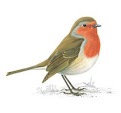
Then there's me. As far as I knew, there was no Saint Robin. But the Mister and I were talking about names, and we did a little digging on the internet, and found a bizarrely-named page in French ("Call Back Me It" for a birthday and saint day reminder service? sounds like some Babelfish translation at work), which says that Saint Robin's day is April 30! I have a day! Too bad it's only 9 days before my birthday. Would have been nice to spread it out a bit. But wait! Another page, this one in Spanish, says that it's September 17! Much better. I can't for the life of me find any info on who "Saint Robin" was, or if they're just making this up, but I'll take it. Presents? Sign me up!
One tidbit I did manage to find is a poem by Sir Edmund William Gosse about "Saint Robin." Even if this is just poetic fancy, I'll be happy to think of the "saint of flowers" who has birds for a choir and a nimbus of daffodils on his head. (Which would, come to think of it, put the logical date for celebration closer to April 30 than September 17...)
With a Copy of Herrick
Fresh with all airs of woodland brooks
And scents of showers,
Take to your haunt of holy books
This saint of flowers.
When meadows burn with budding May,
And heaven is blue,
Before his shrine our prayers we say,--
Saint Robin true.
Love crowned with thorns is on his staff,--
Thorns of sweet briar;
His benediction is a laugh,
Birds are his choir.
His sacred robe of white and red
Unction distils;
He hath a nimbus round his head
Of daffodils.
10 October 2008
This falling
Autumn in Barcelona was bound to be different than in Burlington, or Bloomington, or Brussels. In fact, it is a combination of them all, with the addition of the saturated sun that drenches seaside towns. Although I dearly miss the vivid colors of Vermont and southern Indiana, there are still crunchy leaves and cool nights, that smell in the air of changing weather. We went up into the hills a couple of weekends ago for a friend's wedding, and we shivered in our party dresses (I secretly enjoyed it). And since September and October have been quite rainy, there are hints of the cool gray skies of Brussels.
During the day I can still wear sandals, although in looking around I've noticed that pretty much no one else wears them any more (except for the tourists): it seems that a change of seasons requires a change in wardrobe and footwear, whether or not the temperature is balmy. I always take my jacket with me now, the bright green one that makes me happy. I hope that one of these weekends we'll be able to get out of the city and wade through some fallen leaves.
My favorite autumn poem is Rilke's "Herbst." I may have posted it before, but it is worth savoring again. The "And yet" of the last stanza takes my breath every time.
This poem today is in honor of my grandfather, who is very ill. I pray that he is held "with infinite softness" in God's hands this fall.
Autumn
by Rainer Maria Rilke (tr. Edward Snow)
The leaves are falling, falling as if from far off,
as if in the heavens distant gardens had withered:
they fall with gestures that say “no.”
And in the night the heavy earth falls
from all the stars into loneliness.
We are falling. This hand is falling.
And look at the others: it is in them all.
And yet there is One who holds this falling
with infinite softness in his hands.